Hi again, and welcome to my blog series about making my Print and Play game, ‘Card Bordz’. If you’ve just stumbled across this blog, you can also check out my first blog introducing the game. With the first eight cards designed, it was now time for printing and playing. I had already tested the game a couple of times on my hand-drawn sketches, but this part was much more exciting… it’s really starting to feel like the game is coming to life!

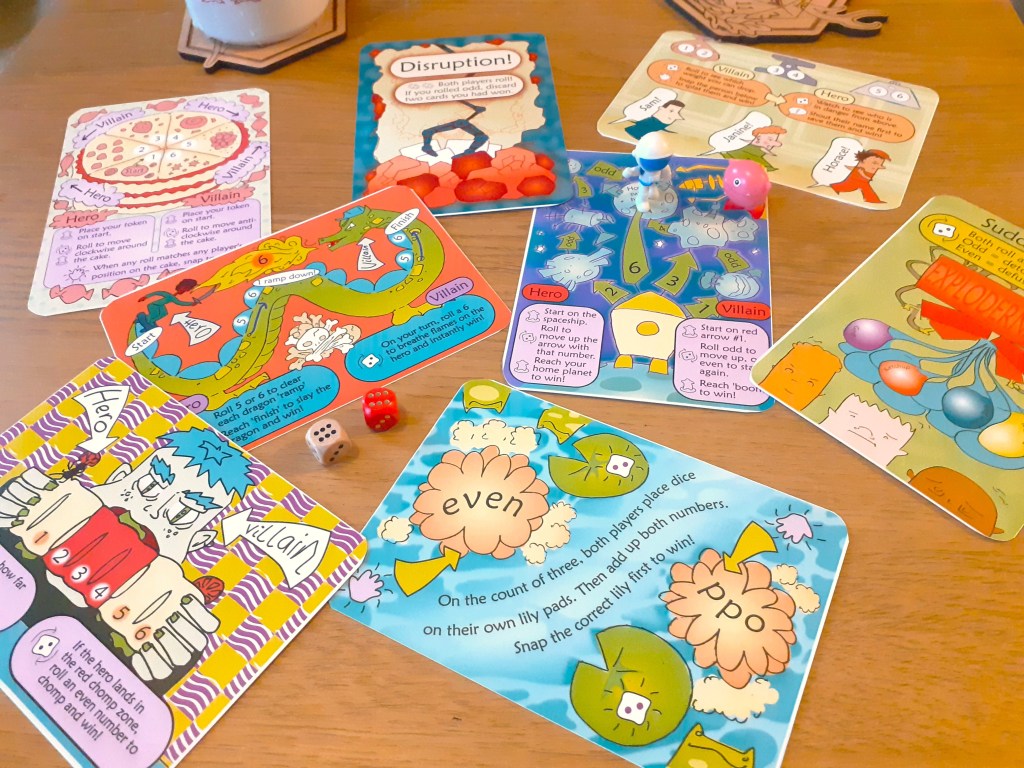
I formatted my cards into PDF pages using Microsoft Publisher (yes, I’m that old-fashioned!) and got them printed on glossy card at a local print shop. They came out about the thickness of a Pokémon card. I’ll have to carry these around for a few days, to see if they wear and tear easily.
I did four cards to each A4 page, so each card is roughly A6 size — bigger than a normal playing card. The cards needed to be big enough for instructions and also have space for tokens to move on. Plus, some minigames involve ‘snapping’ particular spots on the card, so the larger size is needed.
All that remained was to test it! My boyfriend and I played through all the cards using some random plastic figurines as tokens. They were a bit too large for the small boards — I think I’ll have to custom-design some small printable tokens — but it worked well enough. My personal favourite game was “Sandwich Dash”, which can be won or lost in just a couple of rolls. In most games, one player is ‘hero’, and the other the ‘villain’, so the game can be asymmetrical; some cards are biased towards the hero, and some towards the villain. I think this makes Card Bordz the fun kind of infuriating, but we’ll see what others think after playtesting!
The next step is to send to friends and family, so I can see what others think of the game! This can be the frustrating part, because it’s usually necessary to make a lot of changes after someone gives you feedback on the project. But it’s also the most important stage; making edits and responding to feedback is what transforms an average project into something that’s genuinely great! I want this to be something that plays smoothly and makes sense to all types of players.
Until next time…!
 Abi Marie Palmer